

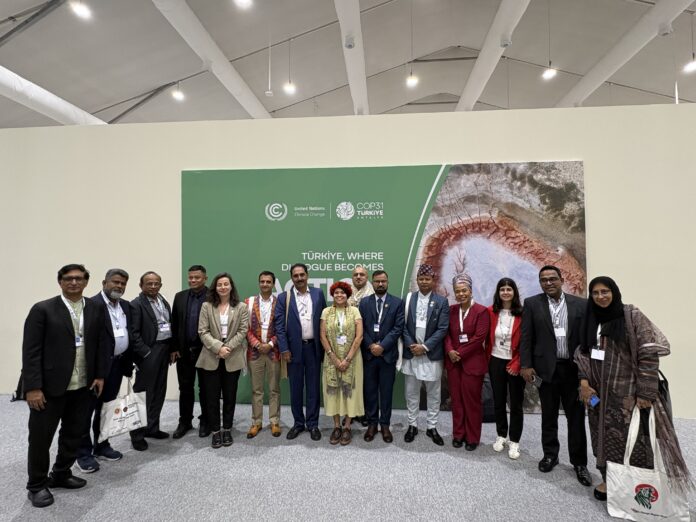
On Monday (16), at COP31 in Antalya, Türkiye, parliamentarians from Brazil, Bangladesh, Bhutan, India, Nepal and Sri Lanka adopted a joint statement on climate communication. The text was read out and approved at the end of the dialogue From Awareness to Action: Strengthening Climate Communication. The dialogue was convened by Plataforma CIPÓ and the South Asia Regional Parliamentary Forum for Climate, Energy and Environment (SARPF), with support from Clima de Política, at the Climate Cooperation Lounge, CIPÓ’s space in the conference’s Blue Zone.
The meeting started from a reality shared by both regions: climate change is already part of people’s lives, through heatwaves, floods, cyclones, droughts, glacial melt and wildfires. The challenge now is to turn that awareness into lasting support for climate action.
The dialogue was opened by CIPÓ’s Executive Director, Maiara Folly, and Professor Mukul Sharma, Co-Director of SARPF. South Asian and Brazilian parliamentarians then took turns speaking. They shared experiences on how to engage citizens on climate and energy, which narratives delay action in their countries, and which tools parliaments have to ensure that reliable information reaches everyone.
Participaram os seguintes parlamentares:
– da Índia, Saleng A. Sangma e N. K. Premachandran;
– do Nepal, Ashish Gajurel e Ashok Kumar Chaudhary;
– do Butão, Birendra Chimoria;
– de Bangladesh, Jahrat Adib Chowdhury e Md. Fazley Houda;
– do Sri Lanka, Chithral Fernando e o professor L. M. Abeywickrama;
– do Brasil, a deputada federal Dandara Tonantzin (PT-MG) e a vereadora de Florianópolis Ingrid Sateré-Mawé (PSOL-SC).
Uolli Longo Briotto, Chief of Staff of the Executive Secretariat of the Secretariat for Institutional Relations of the Presidency of Brazil (SRI/PR), presented the Secretariat’s work with parliamentarians. She also offered SRI/PR’s support to continue the dialogue. SARPF was also represented by Co-Director Sumedha Basu, Operations Lead Ayisha R. Wadhwa and Programme Manager Satyam Malaviya.
Compromissos
Na Declaração Conjunta de Parlamentares do Brasil e do Sul da Ásia, os parlamentares manifestam preocupação com informações enganosas, falsas e manipuladas, incluindo narrativas que não negam a ciência climática, mas buscam atrasar a ação, exagerar seus custos ou disseminar fatalismo. Segundo o texto, essas narrativas estão minando a confiança pública e retardando a implementação.
Entre os compromissos assumidos estão:
– comunicar o clima como uma questão da vida das pessoas, ligada à saúde, ao emprego, à alimentação, à água e ao custo da energia;
– ouvir os cidadãos, e não apenas informá-los, sobretudo mulheres, jovens, povos indígenas e comunidades mais afetadas;
– garantir que alertas antecipados e informações sobre risco de desastres cheguem a todos, em formatos acessíveis e nos idiomas locais;
– apoiar o jornalismo de interesse público e defender jornalistas, cientistas e defensores ambientais;
– promover a democratização da comunicação, com marcos regulatórios que garantam pluralidade, diversidade e liberdade de expressão;
– fortalecer o intercâmbio entre os parlamentos do Brasil e do Sul da Ásia e voltar a se reunir antes da COP32.
The statement also calls on governments, digital platforms and the international community. It urges governments to invest in climate education and early warning systems. It asks platforms for greater transparency on how they recommend and monetize climate-related content. And it calls on the international community to ensure that climate finance also covers public awareness, education and access to information in developing countries.
The statement builds on the COP30 Global Mutirão decision, which recognized for the first time that information integrity is essential for effective climate action.