

CIPÓ and GFNE bring the debate to COP31
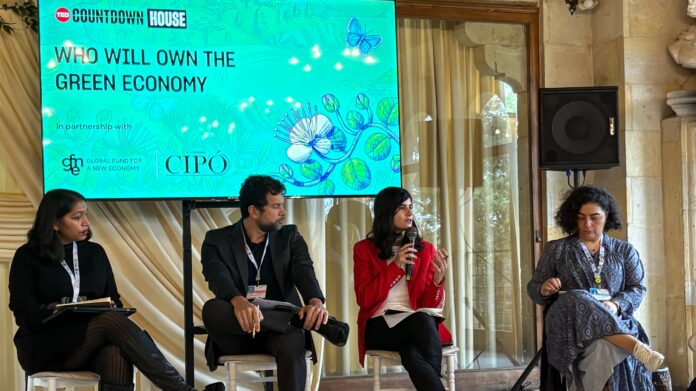
Plataforma CIPÓ and the Global Fund for a New Economy (GFNE) hosted the debate “Who Will Own the Green Economy? Inequality and the Climate Transition” on Tuesday (10) at TED Countdown House in Antalya, Türkiye, during the 31st United Nations Climate Change Conference (COP31).
The discussion started from a question that grows more urgent as the climate agenda moves from commitments to implementation. With trillions of dollars flowing into clean energy, infrastructure, critical minerals and new industries, who will capture the value created by the transition? And who will pay for it? Speaking for CIPÓ, Executive Director Maiara Folly began with the state of the negotiations and sharply criticized the multilateral system. “If developing nations succeed in implementing a just transition, they will do so in spite of, instead of because of, the current multilateral system,” she said.
Folly recalled the commitments of recent years: the New Collective Quantified Goal on Climate Finance, the Baku to Belém Roadmap to 1.3T, the pledge to triple adaptation finance and the agreement to develop a Just Transition Mechanism. What we see now, she said, is a backtrack from these commitments and an attempt to avoid discussing how, when and on what terms these resources will be delivered. “Finance that increases a country’s debt or that does not reach the communities that need it cannot guarantee a just transition,” she said.
Demand, supply and economic transformation
Despite the difficult state of the negotiations, Folly pointed to initiatives outside the negotiating rooms, such as the COP30 Presidency’s Roadmap on Transitioning Away from Fossil Fuels. The roadmap proposes an index that assesses both countries’ dependence on fossil fuels and their capacity to transition away from them. It is organized around three dimensions: demand, supply and economic transformation.
On demand, she cited the debate in Brazil over free public transportation. Transportation costs take up about 18% of family budgets in the country, and during the election campaign President Lula promised free fares on weekends. “This is a very important measure from a well-being and cost-of-living point of view, but it would be important that the discussion on free fares were also accompanied by a discussion on the quality of service and the decarbonization of the transportation system,” she said. Expanding affordable public transportation, she added, also creates an opportunity to electrify bus fleets and to use public procurement to support innovation and quality jobs in Brazil.
On supply, Folly pointed to ways forward such as transforming national oil companies into energy companies with stronger investments in renewables. She also mentioned creating governance structures, such as sovereign funds, to channel oil and gas revenues toward the transition.
On economic transformation, she drew attention to subsidies.
According to the OECD and the International Energy Agency, government support for fossil fuels reached about US$916 billion in 2024. In Brazil, for every BRL 1 in subsidies for renewables, BRL 2.50 goes to fossil fuels. She also highlighted the purchasing power of the state. Public procurement recorded on Brazil’s national procurement portal alone amounts to about BRL 1 trillion, a volume that can create predictable demand for low-carbon technologies.
“A just transition is not inevitable. It must be a core objective of economic strategy, government planning and public spending,” she concluded.
Panel
The panel also included Sonia Mistry, Director of Climate and Labor at the Solidarity Center, and Mireh Atallah, Head of Adaptation and Resilience at the Climate Change Division of the United Nations Environment Programme (UNEP). The debate was moderated by economist Pedro Rossi, Vice President of GFNE.