

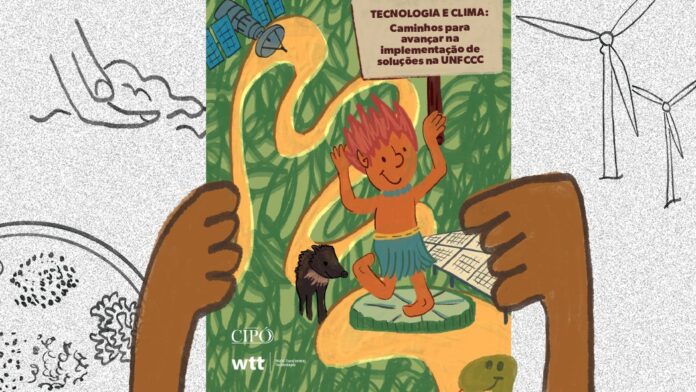
How can climate technologies be made to address the priorities of developing countries? The CIPÓ Platform and World-Transforming Technologies (WTT) are launching, during the 31st United Nations Climate Change Conference (COP31) in Antalya, Turkey, the publication *Technology and Climate: Pathways to Advance the Implementation of Solutions under the UNFCCC*. The study is available in Portuguese, Spanish, and English.
The publication gives an overview of the technology agenda under the United Nations Framework Convention on Climate Change (UNFCCC), from the first debates to the Belém Technology Implementation Programme (BTIP), established at COP30. It also brings together recommendations built in dialogue with more than 60 civil society organizations and social movements across Brazil.
Technology as a Process
The study is based on a broad view of technology, understood not only as a product but as the way societies organize themselves to address their challenges. From this perspective, climate solutions go beyond mitigation and include adaptation, food sovereignty, agroecology, forest conservation, and the knowledge of indigenous peoples and traditional communities.
The analysis shows that, throughout its history, the Convention favored a top-down, North-to-South model of technology transfer over co-production and co-development. The Technology Mechanism’s activities and outcomes still fall short of what it could deliver. The Climate Technology Centre and Network (CTCN), for example, has an annual budget of about US$10 million, while its target is at least US$500 million a year.
BTIP: From Identifying Needs to Implementation
For CIPÓ and WTT, the BTIP is an opportunity to change this model and move from identifying technological needs to implementation at scale. The program calls for annual global dialogues beginning in June 2027, a high-level ministerial dialogue at COP33 in 2028, and a comprehensive review in 2034. CIPÓ and WTT contributed to the selection of the theme for the first dialogue.
Recommendations from Brazilian civil society
The publication outlines three main recommendations: Create instruments for social participation to support technology-related decisions. This includes consultation processes to identify indigenous, traditional, and local technologies; more participatory dialogues within the BTIP; and greater dialogue between the National Designated Entities (NDEs) and civil society.
Strengthen existing instruments by engaging both governmental and non-governmental actors. This includes a CTCN-supported structure to share case studies, ensure data interoperability and incorporate concepts such as social technologies and citizen-generated data.
Create learning instruments and spaces focused on fostering technology co-development processes among Global South countries.
The text was written by Marília Closs, Projects and Research Coordinator at CIPÓ, and Thaís Jesinski Batista, International Policy Consultant at WTT. The publication was supported by the Institute for Climate and Society (iCS) and the Heinrich Böll Foundation.