

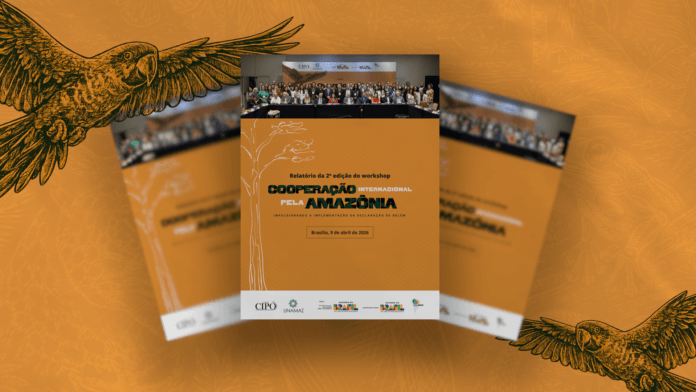
The Plataforma CIPÓ and the Association of Amazonian Universities (UNAMAZ) have launched the report from the second edition of the workshop “International Cooperation for the Amazon: Advancing the Implementation of the Belém Declaration,” held in Brasília on 9 April 2026. The publication systematizes the workshop’s main discussions, which brought together representatives from governments, regional organizations, financial institutions, academia, and civil society to assess the current state of Pan-Amazon cooperation, identify progress and challenges in implementing recent regional agendas, and discuss pathways to strengthen the implementation of the Belém Declaration (2023) and the Bogotá Declaration (2025).
The workshop was organized by Plataforma CIPÓ and UNAMAZ, with the support of the General Secretariat of the Presidency of the Republic, the Presidential Secretariat for Institutional Relations, and the Amazonian Parliament (PARLAMAZ).
According to the report, the Amazon is at a stage where the main regional cooperation frameworks are largely in place, making their effective implementation—and the delivery of tangible results on the ground—the central challenge. Discussions highlighted that, despite significant progress in establishing institutional, financial, and technical mechanisms, there remains a gap between the commitments undertaken by Amazonian countries and their capacity to implement them at scale, in a coordinated manner, and with measurable impact.
Among the key priorities identified are strengthening the institutional capacity of the Amazon Cooperation Treaty Organization (ACTO); expanding access to financing for local actors; enhancing the role of subnational governments, Indigenous Peoples, traditional communities, and civil society in policy implementation; integrating scientific, Indigenous, traditional, and local knowledge into public policymaking; and strengthening the links between data, knowledge, and public policy.
Based on the workshop discussions, the publication presents a set of recommendations to strengthen the implementation of the Amazon agenda and regional cooperation. These include preparing the Sixth Amazon Summit, scheduled for 2027, with a focus on concrete implementation outcomes; advancing ACTO’s financial autonomy; and establishing, by the end of 2026, national eligibility criteria for Indigenous Peoples and traditional and local communities to access the Tropical Forests Forever Facility (TFFF).
The publication also recommends strengthening the alignment between national policies and regional commitments; expanding support for subnational governments; advancing the operationalization of the Amazon Mechanism for Cooperation and Action (MACA); completing the formal launch and operationalization of the Intergovernmental Amazon Technical-Scientific Panel (PITCA); expanding the Regional Amazon Observatory (ORA); and establishing permanent mechanisms to support the implementation of the Belém and Bogotá Declarations.
In addition to assessing the implementation and recent outcomes of Pan-Amazon cooperation, the report analyzes the main outcomes of COP30 for the Amazon, showcases examples of good practices developed by Amazonian countries, and identifies opportunities to strengthen collaboration among governments, financial institutions, multilateral organizations, academia, and civil society.
Workshop Brought Together Representatives from Governments, Academia, and Civil Society
Held in Brasília on 9 April 2026, the workshop brought together diplomatic representatives from Amazonian countries, the Brazilian federal government, ACTO, financial institutions, multilateral organizations, universities, and civil society organizations to discuss ways to strengthen the implementation of the Belém Declaration and deepen Pan-Amazon cooperation. Read more about the event here.
The program included a review of the implementation of the Belém and Bogotá Declarations, an assessment of the main outcomes of COP30 for the Amazon, and discussions on climate finance, evidence-based public policies, science, sustainable development, public security, and combating environmental crimes. The meeting also provided an opportunity to identify good practices developed across Amazonian countries and explore ways to strengthen cooperation among governments, financial institutions, academia, and civil society.