

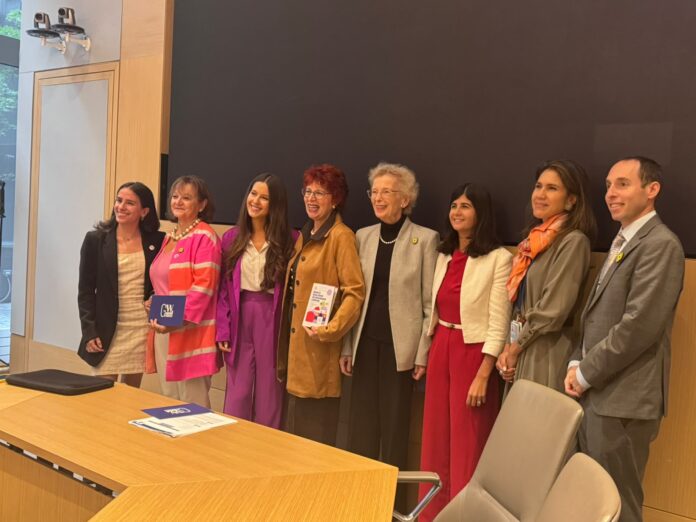
Held during the high-level week of the UN General Assembly, the event brought together Mary Robinson, Susana Malcorra, Maiara Folly, and other leaders to discuss the role of women in the future of global climate governance
On Thursday, September 24, in New York, Plataforma CIPÓ and GWL Voices co-hosted the event “No Implementation without Equality: Women as the Foundation of the Future of Climate Multilateralism.” The discussion examined why gender equality and women’s full participation are fundamental to translating international climate commitments into concrete results.
Organized during Climate Week NYC 2026 and the high-level week of the 81st session of the UN General Assembly, the event took place at the Bahá’í International Community’s offices near UN Headquarters and brought together leaders working across diplomacy, climate, human rights, and gender equality.
The panel featured Mary Robinson, co-founder of Project Dandelion, the first woman President of Ireland, and former UN High Commissioner for Human Rights; Susana Malcorra, President of GWL Voices; Maiara Folly, Executive Director of Plataforma CIPÓ; Catalina Santamaria, Senior Environment Programme Management Officer at the Executive Office of the UN Secretary-General; and Dan Perell, Representative of the Bahá’í International Community. Renata Koch Alvarenga, founder of EmpoderaClima, moderated the discussion.
The conversation took place against the backdrop of the challenge of moving global climate commitments from negotiation to implementation. In this context, a central focus was the “two-tier climate multilateralism” approach, which Plataforma CIPÓ analyzes in its publication Two-Tier Climate Multilateralism: The Legacy of COP30. This perspective upholds the importance of consensus-based multilateral negotiations while combining them with more flexible, implementation-oriented mechanisms, such as coalitions, finance mobilization, and new institutional arrangements.
“Consensus-based negotiations provide direction and legitimacy, while the second tier brings together the actors and coalitions capable of accelerating implementation. The gender equality agenda can be an entry point for connecting these two tiers,” said Maiara Folly.
According to Folly, the normative progress achieved at COP30 must be matched by concrete implementation mechanisms, especially in climate finance. “We need quantitative indicators to track progress. If we are serious about implementation, we need to set targets and know how much climate finance is actually reaching women,” she said.
Speakers stressed that, in this process, gender-disaggregated data, gender-responsive climate finance, and women’s full and equal participation must be built into implementation frameworks from the outset, rather than treated as peripheral elements of climate action.
A highlight of the event was the presentation of GWL Voices’ new report, Spotlight on Women in Global Climate and Environmental Leadership, which analyzes three decades of women’s participation in leadership positions in international climate and environmental governance. According to the report, since 1992 only about a quarter of UN climate COP presidencies have been held by women. Across the seven leading international climate and environmental institutions analyzed in the study, women were at the helm for approximately 30% of the period reviewed.
The discussion also turned to inequalities in climate finance. OECD data compiled for the event show that, in 2022, only 4% of official development assistance (ODA) for climate adaptation had gender equality as its principal objective. For mitigation funding, the share was 2%.
In the run-up to COP31, the event sought to reinforce the message that accelerating climate implementation must go hand in hand with greater representation in decision-making spaces, adequate financing, and policies that take into account the diverse experiences and impacts of the climate crisis — with particular attention to strengthening the leadership of women and young people from the Global South.