

New York gathering brought together diplomats and civil society to advocate for transparency, public scrutiny, and the election of the first female Secretary-General
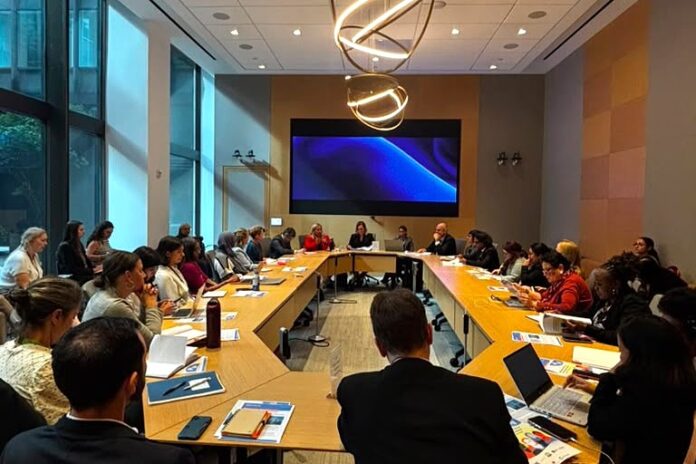
During UN High-Level Week, the 1 for 8 Billion campaign—in partnership with the Government of Estonia—hosted the eventCrunch time: upholding transparency, integrity and the General Assembly’s agency in the final phase of the Secretary-General selection processThe event brought together government officials, diplomats, and civil society representatives to discuss the decisive stage of choosing who will lead the United Nations starting in 2027. CIPÓ is part of the 1 for 8 Billion steering committee, which advocates for a more inclusive, transparent, and diverse selection process for the next Secretary-General.
Held on September 22 in New York, the meeting featured Minna-Liina Lind, Estonia’s Deputy Minister for Global Affairs; Ambassador Martín Vidal, Director-General for Political Affairs at Uruguay’s Ministry of Foreign Affairs; Jane Kinninmont, CEO of the United Nations Association–UK (UNA-UK); and Maria Noel Leoni, Campaign Director for GQUAL.
Discussions addressed key themes including protecting the transparency gained in recent selection processes, the risk of last-minute candidacies aimed at evading public scrutiny, electing the first woman to the position, and safeguarding the independence of whoever assumes the role, as enshrined in Article 100 of the UN Charter. Concerns were also raised regarding decision-making within the Security Council, which is responsible for recommending a candidate to the General Assembly. In this regard, Estonia—through the Accountability, Coherence and Transparency (ACT) group—has argued that the Council should present more than one candidate, allowing the General Assembly to make the final choice. Accountability, Coherence and Transparency (ACT)has argued that the Council should present more than one candidate, allowing the General Assembly to make the final choice.
In her welcoming remarks, Kinninmont emphasized that the choice will have a massive impact on the UN’s capacity for renewal and that whoever takes the role will require broad support from the General Assembly to operate effectively. Opening the session, Lind warned that the UN stands at a crossroads and that all stakeholders in the process share the responsibility of saving multilateralism. “With so many ongoing wars, it is vital to select a Secretary-General not just for the Security Council, but so that people around the world feel that this is someone who will make their lives better,” she stated. Vidal, for his part, presented the position of the Community of Latin American and Caribbean States (CELAC), united around the principle that the next Secretary-General should come from the region. Meanwhile, Leoni summarized the push for electing a woman to the position: “there are infinite reasons why this matters, and zero why it doesn’t.”