

Researchers, lawmakers, and civil society representatives gathered in Brasília to discuss alternatives to the current development model
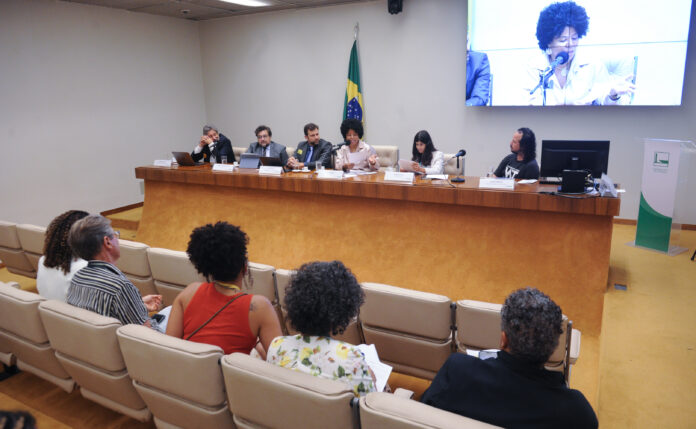
Lawmakers, researchers, representatives of civil society, social movements, and international organizations gathered this Tuesday (19) at Brazil’s Chamber of Deputies, in Brasília, for the seminar “A New Economy for Fair, Sustainable, and Sovereign Development.” Organized by Plataforma CIPÓ and Transforma Economia – Unicamp, with support from the Global Fund for a New Economy (GFNE), the Climate Working Group of the Environmentalist Parliamentary Front, and the Heinrich Böll Foundation, the event promoted debates on economic alternatives in the face of the climate crisis, rising inequality, and transformations in the world of work.
Opening the seminar, CIPÓ’s Executive Director and Co-founder, Maiara Folly, stressed that today’s crises are not the result of isolated failures, but rather a direct consequence of the way the global economy is structured. “The richest 10% of the world’s population hold 54% of global income and 74% of global wealth,” she noted. According to Folly, the current economic model is built on “the production of inequalities, the concentration of wealth, the generation of polluting emissions, and extractivism.”
For Folly, building a new economy requires political and institutional action. “We need regulatory frameworks, including to create incentives for what we consider public policies aligned with a new model of economic development.”
Wealth concentration and inequality at the center of the debate
Throughout the event, participants argued that the ecological and social transition cannot be treated merely as a technical or environmental adjustment, but rather as a structural transformation of the country’s economic and political foundations. GFNE Vice President Pedro Rossi argued that the neoliberal paradigm no longer responds to contemporary challenges. “Inequality undermines Western democracies,” he said.
In the same vein, Transforma Executive Director Marco Antonio Rocha argued that it is necessary to build a collective project capable of once again mobilizing society around concrete prospects for change. “Politics needs to inspire people again with the possibility of real change in their lives.”
Sérgio Gabrielli, professor at the Federal University of Bahia (UFBA) and former president of Petrobras, highlighted the need to rethink the very foundations of economics in light of ongoing social and environmental transformations. “Our economy, as a theoretical framework, is still in the 16th century — if not the 17th century,” he stated. According to Gabrielli, economic debate must once again place “life and survival” at the center of political decision-making.
Speakers point to the limits of the neoliberal model
The international dimension of the debate emerged in remarks by Mayra Juruá, National Programme Management Officer at the Economic Commission for Latin America and the Caribbean (ECLAC). According to her, the climate crisis is already producing concrete impacts and will deepen historical inequalities unless structural changes are implemented.
“Marginal adjustments will not be enough. We need structural transformations,” she argued. Juruá warned that decarbonization alone does not guarantee development. “We need to discuss how we are going to carry out this decarbonization and how we are going to achieve green productive development.”
Alessandra Cardoso, political advisor at the Institute for Socioeconomic Studies (INESC), criticized the limitations of current climate finance and ecological transition policies. In her view, many of the instruments currently presented as green solutions end up reinforcing traditional sectors of the economy.
“These mechanisms are much more oriented toward reshaping the old economy than toward an actual ecological transformation and the construction of a new economy,” she said. Cardoso defended greater public investment in climate adaptation, socio-bioeconomy initiatives, and the protection of territorial rights.
Debate on a new economy includes work and quality of life
Lucas Sidrach, member of the Beyond Work Life Movement (VAT), linked the rise of precarious freelance contracting and app-based labor platforms to increasing worker exploitation and illness. “The precarization of work has been modernized through new tools,” he observed.
Advocating for shorter working hours and the end of Brazil’s 6×1 work schedule, Sidrach argued that economic debate must incorporate culture, well-being, and healthier human relationships. “I truly hope that the GDP of Minas Gerais will be driven by Milton Nascimento’s music, not by the destruction of our mountains.”
The seminar also brought together representatives from the Institute for Applied Economic Research (Ipea), the Climate Observatory, Brazil’s Ministry of Finance, the Council for Sustainable Economic and Social Development (Conselhão), as well as lawmakers such as Jack Rocha (PT-ES), Chico Alencar (PSOL-RJ), and Bohn Gass (PT-RS), who contributed perspectives on democracy, ecological transition, and sustainable development in Brazil.
Photo: Renato Araújo / Câmara dos Deputados