

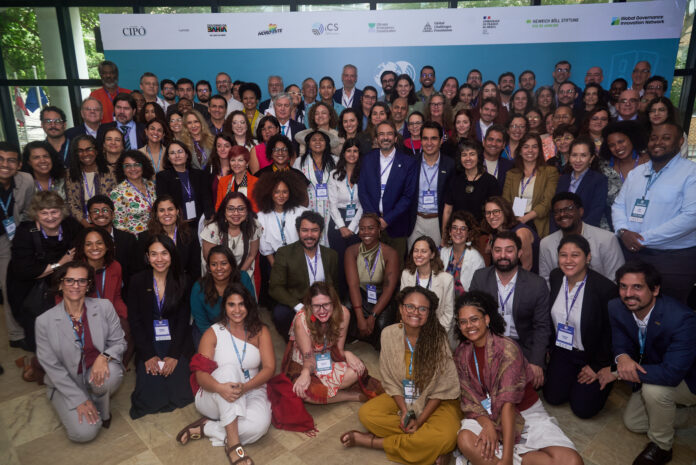
The event, held on May 25th and 26th in Salvador, gathered members of the COP30 Presidency, Brazilian authorities, international organizations, and representatives from Australia, Turkey, and Ethiopia to discuss climate implementation, finance, and the future of multilateralism.
Representatives from more than 20 countries, members of the COP30 Presidency, Brazilian authorities, international organizations, academia, and civil society met this Monday (25th) in Salvador for the first day of the Global Policy Dialogue 2026. The international event explores paths for global climate governance following the climate conference held in Belém. Organized by Plataforma CIPÓ, the GPD is themed “From Commitment to Implementation: The Legacy of COP30 and Paths to Strengthen Global Climate Governance.”
The discussions are conducted under the Chatham House Rule, which allows for the use of information debated without identifying the participants or directly linking statements to the institutions represented. The quotes attributed in this text were provided during interviews conducted throughout the event.
Prominent attendees on the first day included Federal Deputy and former Minister of Indigenous Peoples, Sonia Guajajara; COP30 President, Ambassador André Corrêa do Lago; and representatives from the countries hosting upcoming climate conferences—Australia and Turkey, which will preside over COP31, and Ethiopia, the host of COP32. The event also featured participants from countries across Latin America, Africa, Europe, Asia, and the Middle East.
Plataforma CIPÓ’s Executive Director, Maiara Folly, highlighted that the meeting seeks to deepen the debate on the political and institutional legacy of COP30 and the mechanisms to transform commitments into concrete implementation. “Today, we discussed at length the concept of two-level multilateralism: what must be done for the Climate Convention to function with its initial purpose of ensuring countries reach consensual decisions, while also adding its second level, which is the level of implementation.”
In her assessment, it is essential to preserve the COP as a “legitimate space for consensus-building and to advance implementation through coalitions and by accelerating climate action across countries, states, municipalities, and territories.”
COP30 President, Ambassador André Corrêa do Lago, assessed that the conference held in Belém succeeded in boosting the international debate without losing sight of the need to accelerate climate action. “Without multilateralism, we would not be anywhere near where we are today. However, we must go much faster and further,” he stated. “I believe COP30 found a very good balance between being encouraged by what has already happened and remaining conscious that there is still much to be done.”
Federal Deputy and former Minister Sonia Guajajara underscored the need to expand listening and social participation processes in international discussions on climate and energy transition. “CIPÓ has been democratizing the debate on Brazilian foreign policy and global geopolitics—which is not disconnected from the agreements and solutions we need to build to address climate change, achieve a just energy transition, and strengthen trade relations, while considering inclusion processes such as free, prior, and informed consent for Indigenous and traditional peoples,” she opined. “We need a collective effort to truly listen to these voices.”
The Vice-Governor of Bahia, Geraldo Júnior, reinforced the importance of the climate agenda for the state, the Northeast region, and the country. “This is a topic of extreme importance for Bahia, the Northeast, Brazil, and the world,” he said. According to the Vice-Governor, three themes are priorities: “environment in national and international discussions; implementation of what was negotiated at COP30; and establishing public policy for economic development with social and environmental responsibility, without hindering economic progress.”
The Executive Secretary of the Northeast Consortium, Carlos Gabas, highlighted the meeting’s importance in strengthening the implementation of just, sustainable, and inclusive ecological transition policies in the Northeast. According to him, the Caatinga represents a strategic territory for climate solutions, bioeconomy, and environmental regeneration, while also expanding opportunities for international cooperation.
For the young COP30 climate champion, Marcele Oliveira, one of the meeting’s distinct features is its collaborative and international nature. “The GPD is a gathering that brings together diverse actors across various scales of action—from movements and civil society to government and international organizations.” She added, “I think that having 20 countries represented here, plus Brazil, makes the value of this meeting impossible to measure.”
The Undersecretary for Ecological Transformation at the Ministry of Finance, Carolina Grottera, highlighted the role of the COP30 Finance Ministers’ Circle and presented initiatives focused on implementing climate and low-carbon economic policies.
“I had the opportunity to speak a bit about our role in the Finance Ministers’ Circle, which was one of the four strategic circles of COP30, and how this translates into concrete actions that the Ministry of Finance has been implementing, such as the TFFF (Tropical Forests Forever Facility), the Open Coalition for Regulated Carbon Markets, the Harmonization of National Taxonomies, and also the Country Platforms, which host strategic projects for a low-carbon economy,” she noted.
Throughout the day, debates addressed topics such as the reform of international climate governance, climate finance, trade and climate, just ecological transition, adaptation, combating deforestation, and the institutional mechanisms created since COP30. The program also included working groups focused on the COP30 Presidency’s Action Agenda and the “roadmaps” for transitioning away from fossil fuels and combating deforestation.
Discussions continue this Tuesday (26th), focusing on strategies and priorities for COP31, COP32, and the future of climate multilateralism.
The event is organized by Plataforma CIPÓ, in partnership with the Government of Bahia, the Northeast Consortium, the Institute for Climate and Society (iCS), the Climate Emergency Collaboration Group, the Global Challenges Foundation, the Embassy of France in Brazil, the Heinrich Böll Foundation, and the Global Governance Innovation Network.