

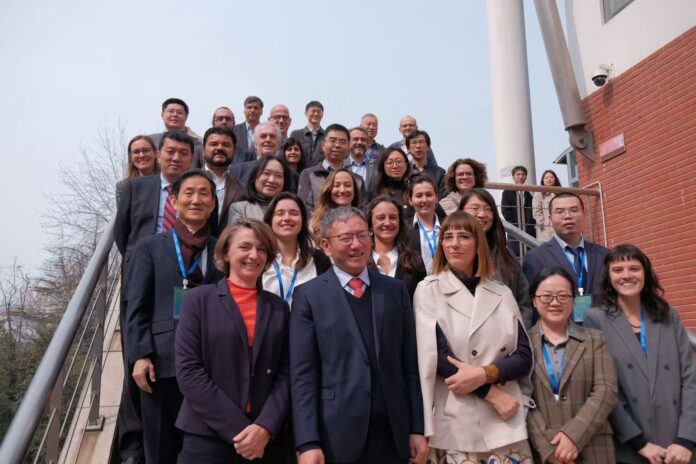
Between March 20 and 27, Plataforma CIPÓ’s Executive Director, Maiara Folly, took part in an international mission to China alongside experts and civil society representatives from both countries. The agenda focused on strengthening bilateral cooperation on issues such as climate, energy transition, land use, sustainable trade, and green development.
In addition to CIPÓ, the Brazilian delegation included the Amazon Environmental Research Institute (IPAM), the Institute of Forest and Agricultural Management and Certification (ICV), the Amazon Institute of People and the Environment (Imazon), the O Mundo Que Queremos Institute, and the Institute for Climate and Society (iCS).
Among the key engagements was a meeting with Professor Wang Mou, Executive Director of the Research Center for Sustainable Development at the Chinese Academy of Social Sciences, held on Friday (March 20). The discussion focused on international cooperation, potential areas for partnership within Brazil–China relations, and institutional synergies.
Folly also participated in the workshop “China-Brazil Exchange Workshop: Promoting Scientific Research on Climate & Nature,” held on Monday (March 23) at the Landmark Convention Center. In the panel “Implementing NDCs in the Context of China-Brazil Cooperation,” she highlighted differences in the emissions profiles of the two countries. While China still shows a strong dependence on coal, Brazil’s emissions are primarily concentrated in land-use change and deforestation. According to her, these differences require distinct strategies, but also create opportunities for complementary agendas.
On Tuesday (March 24), the Executive Director took part in “The 4th International Symposium on China-Latin America Green Future and Sharing Civilizations,” which brought together academics, experts, research institutions, and civil society organizations. The event addressed China–Latin America cooperation on issues such as climate, agriculture, land use, biodiversity, and ecological transition.
In her remarks, Folly emphasized the growing role of Brazil–China cooperation in advancing just transitions, highlighting the need to align economic development, emissions reduction, and inequality mitigation. The discussion pointed to concrete opportunities for bilateral collaboration, particularly in areas such as supply chain traceability, forest restoration, bioeconomy, and energy transition, including joint progress in clean technologies and industrial innovation. She also underscored that strengthening multilateral mechanisms and South–South cooperation initiatives can help translate these agendas into practical and scalable outcomes.
Evento em Xangai reuniu lideranças para discutir cooperação econômica Brasil–China
Durante a missão, Folly acompanhou o Brazil–China Summit, realizado em Xangai e organizado pelo Valor Econômico, em parceria com o Centro Brasileiro de Relações Internacionais (CEBRI). O encontro reuniu autoridades, executivos e especialistas para discutir o aprofundamento das relações econômicas entre os dois países, com painéis sobre transição energética, infraestrutura, inovação tecnológica, agronegócio e finanças sustentáveis.
Já no dia 26 de março, a delegação visitou a Embaixada do Brasil na China. Em pauta estiveram projetos de cooperação Brasil–China, o papel de instituições chinesas na governança climática, a agenda das Conferências das Partes (COPs) e o Tropical Forest Forever Facility (TFFF).