

Originally published in PassBlue
Ben Donaldson and Aditi Gorur*
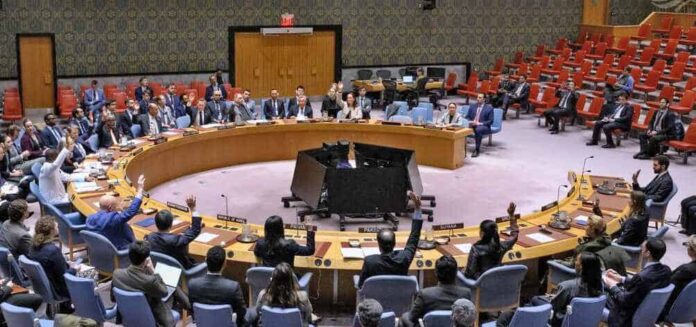
Soon, the United Nations Security Council will begin meeting with candidates vying to be the next UN secretary-general. The world will follow along as the 15-member Council starts holding private consultations in the coming days, releases occasional media statements and votes in secret straw polls to express their views on the nominees.
But another, even more shadowy process is likely also underway: Backroom deals between candidates and the most-powerful Council states.
It is no secret at the UN that Security Council members try to extract promises from secretary-general candidates in exchange for their votes — but little has been made public about how these backroom deals are struck. A new report from the 1 for 8 Billion advocacy campaign sheds light on this phenomenon, drawing on more than 40 interviews with former diplomats, candidates from previous races and former senior officials.
The report contains credible allegations suggesting that all five permanent (P5) members (Britain, China, France, the US and Russia) of the Council have unduly compromised the independence of candidates over the course of the UN’s history, including the incumbent, António Guterres.
One of the most clear-cut modes of influence are quid pro quos for top UN jobs. In these instances, a country (typically a P5 but not always) indicates to a candidate that its backing is conditional on the appointment of one of its own nationals to a prominent UN role. The most dangerous moment for these deals is during the straw poll process (scheduled to begin the last week of July), particularly toward the end, when the P5 use a different color of ballot papers than the 10 elected members. Getting a “discourage” vote on a permanent member’s red ballot signals a likely veto. It is often fatal to a candidate’s chances, placing significant pressure on the person to make accommodations with the permanent member they suspect may have cast it.
Perhaps more insidious and influential than these explicit trades is a general expectation that states are owed a favor to be named later in thanks for their support. While some UN leaders have walked the campaign tightrope better than others, none have been entirely unscathed.
The report details 13 examples of credibly alleged attempted quid pro quos — about half of them seemingly accepted — implicating all P5 members. These instances include:
- Kurt Waldheim in 1971 creating the single post of under-secretary-general for Political Affairs, Trusteeship and Decolonization and giving it to a Chinese national, seemingly in return for China not blocking his candidacy;
- A French national taking the role of leading UN peacekeeping in return for French support of Kofi Annan’s 1996 candidacy (a job that has been held by a French national since);
- An American national being installed in the UN’s senior-most political role in thanks for US support of Ban Ki-moon’s 2006 candidacy (a US national has held this position ever since);
- A 2006 UK request to Ban Ki-moon during his candidacy that a British national be installed as head of Political Affairs, though the British settled for the position of head of humanitarian affairs (which a British national has held since);
- Russia requesting in 2016 the installment of a Russian national in a senior headquarters role in thanks for Russia agreeing to Guterres’s candidacy in 2016. Guterres subsequently created the UN Office of Counter-Terrorism (OCT) with a Russian appointed to head it, which remains the case since.
These backroom deals harm the UN by undermining the independence and quality of its top officials, who were in many cases not appointed through fair, merit-based processes – and some of whom may serve national interests instead of the world’s best interests. They shut out talented individuals, particularly those from the global South, from the most consequential roles in the UN. National monopolies also directly contravene a host of General Assembly resolutions.
This year, however, the stakes are even higher for these secret deals between candidates and powerful member states. The UN is under extreme financial and political pressure to reform, and the world is expecting the next secretary-general to take bold steps to adapt the organization to today’s geopolitical realities. If the next UN leader has already promised to protect the interests of the powerful and allocate key roles to certain countries before taking the post, their hands will be tied on reform and they will be set up for failure before they have even begun their term.
Countries around the world must speak out this year to tell the candidates that they are expecting them to shake up the organization and appoint the best possible team – that means rejecting backroom deals on senior appointments and national monopolies on top jobs. The 1 for 8 Billion campaign is asking all candidates to uphold the Principles for Integrity in UN Secretary-General Campaigns.
This includes a pledge to “protect the principle of independence from member states, including with respect to appointments to senior posts.” So far, four of the candidates have publicly endorsed the Principles: Michelle Bachelet, María Fernanda Espinosa, Rebeca Grynspan and Carolyn Rodrigues Birkett. (The two who have not are Macky Sall and Rafael Grossi.)
Political pressure must be applied to the powerful countries willing to use their influence in the appointment process for narrow national interest at the expense of the UN’s credibility and effectiveness. We need to hear from most countries that they will no longer tolerate the old, harmful patterns of stitch-ups and status quo.
Of course, the reality of diplomacy is that the secretary-general will always have to navigate the expectations of powerful states. And secretaries-general should be accountable to governments chosen by the peoples they ultimately serve. But this opaque trade in favors places too much power into too few hands. It critically hampers the winning candidate’s ability to pursue bold reforms and build the talented and diverse teams they will need. By fighting back against the assumption that the UN’s top posts should be divided among a few powerful countries, we will give the winning candidate, whoever they may be, a fighting chance.
* Nycolas Candido, from Plataforma CIPÓ, and Fred Carver, from Strategy for Humanity, also participated in writing this article.