

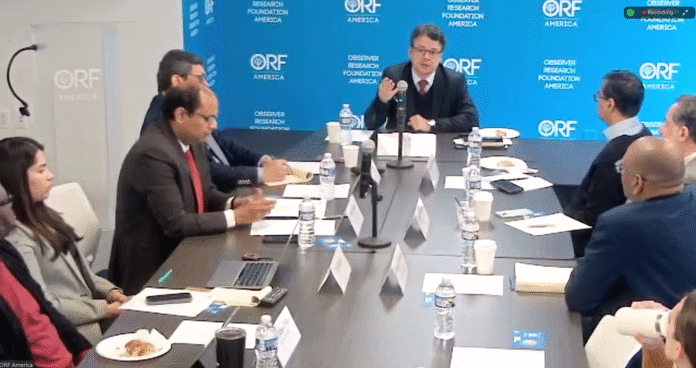
The Observer Research Foundation America (ORF America), in partnership with Plataforma CIPÓ, held on Thursday (December 4), in Washington, D.C., the hybrid event “The Post-COP30 Agenda: Reflections from Belém and the Road to 2026”, dedicated to examining the outcomes of COP30 and their implications for global climate governance. The gathering brought together experts, government representatives, and civil society stakeholders to discuss key issues on the climate agenda, including climate finance, just transition, protection of tropical forests, and the continuation of negotiations within the G20, BRICS, and future COPs.
The opening session featured Dhruva Jaishankar, Executive Director of ORF America, followed by the keynote address delivered by Counselor Fernando Perdigão of the Embassy of Brazil in Washington, D.C.
Representing Plataforma CIPÓ, Executive Director and Co-Founder Maiara Folly emphasized the political importance of the Belém package and the key advancements achieved during COP30. According to her, the outcomes represent “a victory for multilateralism,” particularly in a geopolitical context marked by tensions and by an international negotiation process that still requires structural reforms to enhance implementation capacity.
Folly noted that, despite concerns that the United States’ withdrawal from the Paris Agreement might trigger a domino effect of further departures, this did not materialize. “Countries remained engaged in good faith. The negotiations were complex, but we nonetheless reached 29 substantive decisions, an achievement that deserves recognition,” she stated.
Among the priority issues for Brazil and for CIPÓ, Folly highlighted the importance of just transition, noting that the topic had faced significant deadlocks in recent years. The work program approved at COP30 led to the creation of an institutional mechanism designed to support countries in developing transition pathways that balance sustainability, equity, and social inclusion.
The Executive Director also underscored important progress in integrating human rights considerations into climate decisions. For the first time, an official COP text recognized the role of people of African descent in climate action — a longstanding priority of Brazilian diplomacy and a significant milestone for climate justice.
The event in Washington reaffirmed the importance of international dialogue and collective action in addressing the climate crisis, outlining pathways for the post-COP30 period and for the strengthening of a more just, effective, and inclusive system of global climate governance.